Brazilian Jiu-Jitsu
Ground skill built in Brazil. Brazilian jiu-jitsu grew from judo lessons in Brazil into a worldwide grappling sport. Its roots, the Gracie family, belts and big events.
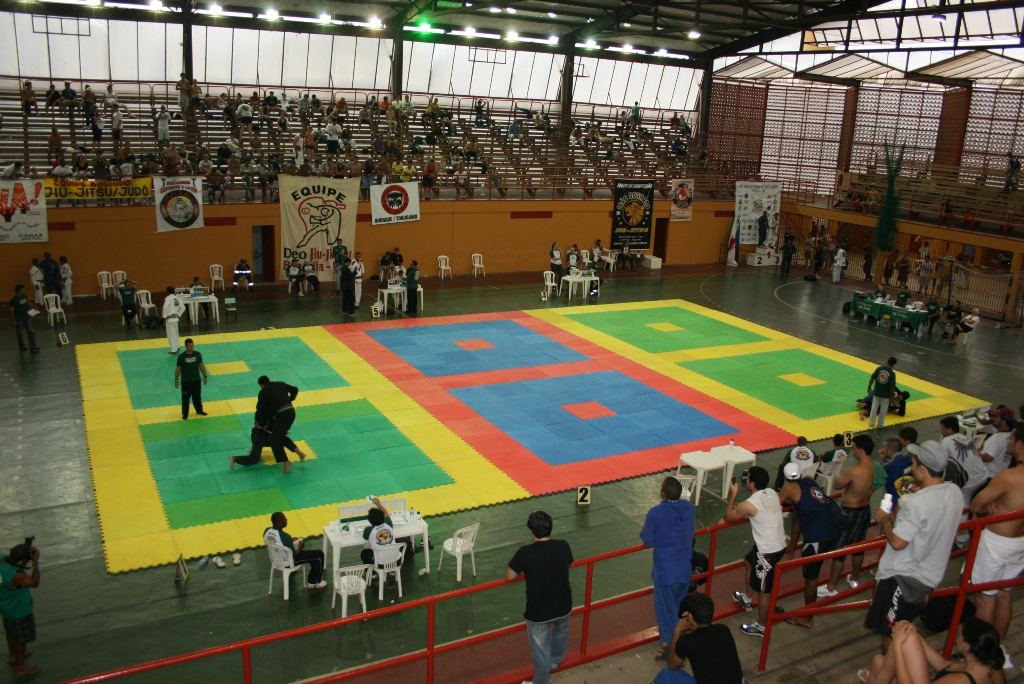
A Brazilian championship match: Cid Costa Neto, CC BY-SA 3.0
From Maeda to the Gracie family
Brazilian jiu-jitsu began with a traveller. Mitsuyo Maeda, a judo expert from the Kodokan in Tokyo, left Japan in 1904 and toured many countries giving demonstrations. He reached Brazil in 1914 and settled in the northern city of Belem.
Around 1917 a teenager named Carlos Gracie saw one of his demonstrations and began training. Historians still debate how much Carlos learned from Maeda himself and how much from Maeda's student Jacyntho Ferro, but either way the knowledge passed to Carlos and then to his brothers.
The Gracie brothers opened an academy in Rio de Janeiro in the 1920s. The youngest, Helio Gracie, was slight and often unwell, so he adapted what he learned to rely on leverage and timing instead of strength. That idea, that a smaller person can hold their own through skill, became the heart of the art.
Helio lived from 1913 to 2009 and is often called the godfather of the style. His children and the wider Gracie family helped carry it across Brazil and later to the United States and the rest of the world.
How the sport works
Brazilian jiu-jitsu is a grappling art. There is no striking in sport matches. Athletes start standing, take the contest to the mat and work for control, scoring points for positions such as getting past the opponent's legs or reaching a stable top position.
A match can also end early when one athlete taps to signal they give up, which is the reason training feels safe: partners stop instantly when someone taps. Matches can be done in the traditional gi, a heavy cotton uniform, or in no-gi gear such as rash guards and shorts.
Belts and big events
Adults move through white, blue, purple, brown and black belts, with stripes marking progress in between. Under IBJJF rules a student must be at least 16 for blue belt and 19 for black belt, and black belt usually takes about a decade of steady training.
The International Brazilian Jiu-Jitsu Federation, founded in 1994, runs the World Championship, known to fans as the Mundials. Today academies can be found in almost every country, and many beginners join for fitness, problem solving and friendship.
Your first class
Most academies offer a free trial. Beginners usually start with warm-ups, rolling and breakfall drills, and simple position work with a partner. Short nails, clean kit and a calm attitude make you a welcome training partner from day one.
Ask about beginner-only sessions, and never be shy about tapping early. Good coaches keep training controlled, and the culture of looking after your partner is what lets people train for decades.
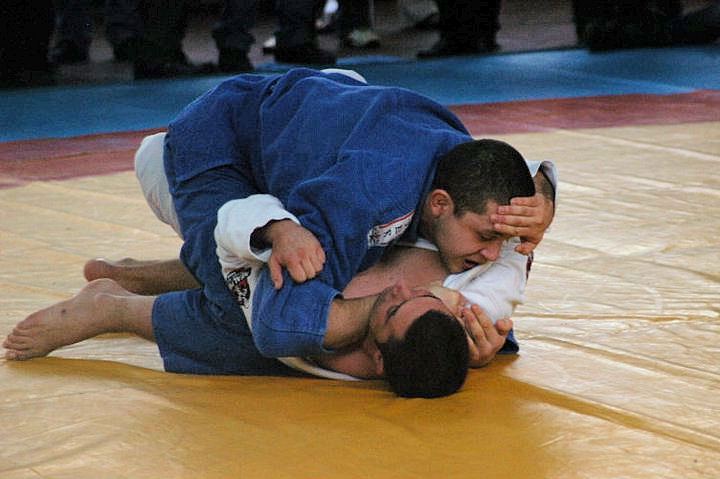
- A Brazilian championship match: Cid Costa Neto, CC BY-SA 3.0
- Training on the mat: Teraforming, CC0
Text written by Strongest Power.